
Erasmo Iacovone and the Taranto dream that never really died
Before tragedy froze one of Italian football’s most powerful lower-league stories, Erasmo Iacovone had become far more than Taranto’s centre-forward. He was the face of a city trying to hold on to itself.
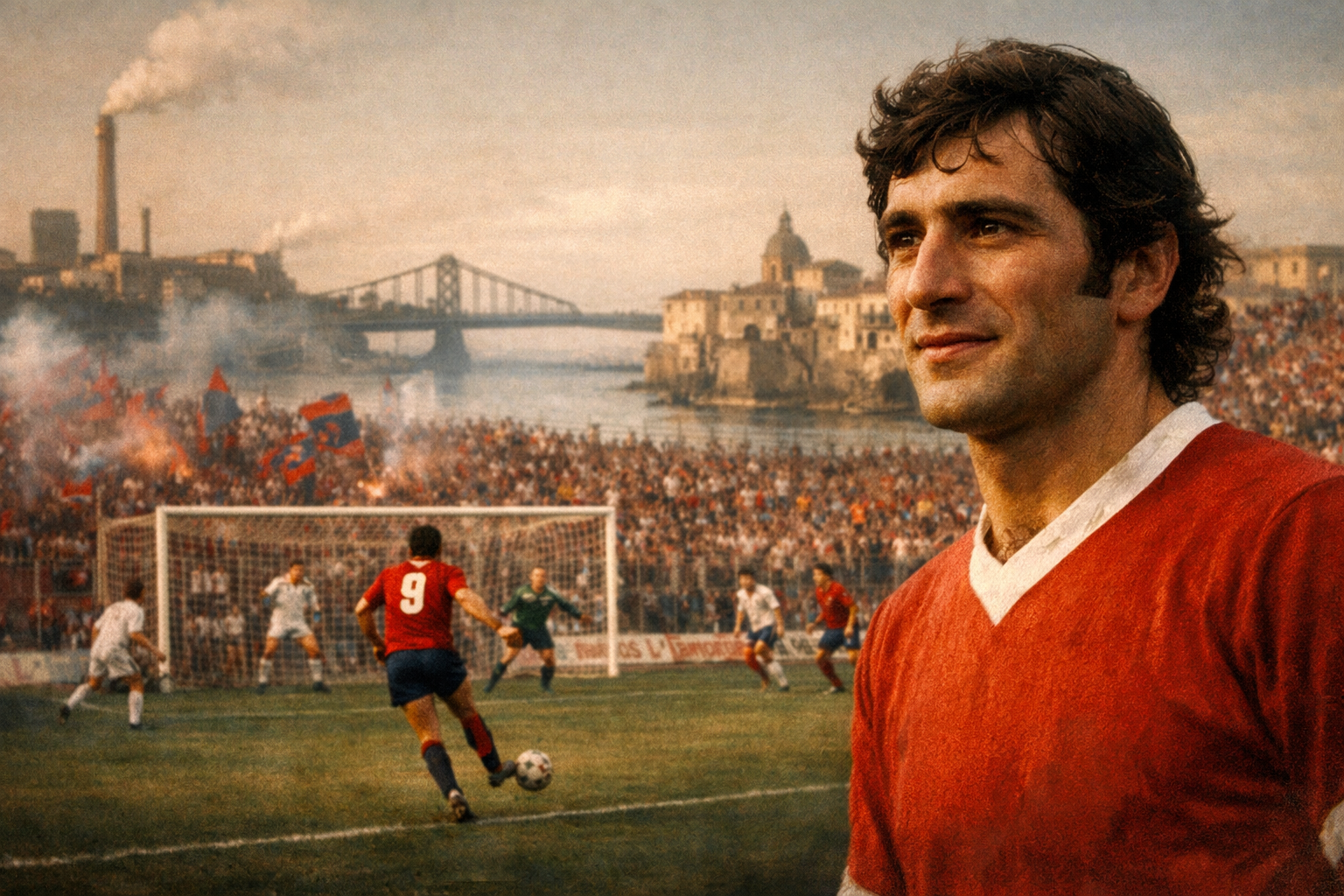
Taranto is one of those football cities that makes perfect sense even before you check the honours list.
The support is real. The identity is deep. The relationship between club and place runs far beyond results. And yet, for all of its size, history and civic pride, Taranto remains one of Italy’s biggest cities never to attach its name to a Serie A side.
That absence matters there.
Set on the Ionian coast in Apulia, Taranto has long lived with contrasts. It is a city of ancient heritage and natural beauty, but also one shaped by the heavy industry that transformed its economy after the Second World War. The rise of the steelworks and surrounding industrial complex brought jobs, growth and modernisation, but at a severe environmental and social cost. In time, Taranto became a place suspended between sea and smoke, between promise and exhaustion.
In that sort of landscape, football can become more than football. It can offer a shared language, a form of relief, even a kind of civic self-belief.
That is why Erasmo Iacovone still means so much.
He was not simply Taranto’s striker. He became the player who gave the city a version of itself to believe in.
The season Taranto started to dream
By the 1977-78 campaign, Taranto were no strangers to Serie B. The club had settled into the division and entered that season with a squad that was solid rather than glamorous. There were useful additions, but this was not a team built around wealth or star power.
What changed was the force at the top of the pitch.
Iacovone, signed from Mantova the previous year, had already made an impression in his first season. By the midpoint of 1977-78, he had gone further, becoming the focal point of a Taranto side that emerged as a genuine promotion contender behind the outstanding Ascoli.
For a club with no top-flight history, that mattered enormously. Promotion was no longer an abstract fantasy. It was there in the table, there in the stadium, there in the way people spoke about Sunday.
Iacovone was central to all of it.
Born in 1952, he was not the obvious prototype of a star striker. He was not especially tall, and he was not known as the most refined technician in a forward line that also included more naturally elegant players. But he attacked the air brilliantly, timed his movement sharply and played with a determination supporters instantly recognised. Many of his goals came with his head, despite standing at only 1.74 metres.
Taranto’s president, Giovanni Fico, had not initially been fully convinced by the fee required to bring him in. It took persuasion from assistant coach Tommaso De Pietri, who knew Iacovone from an earlier spell at Carpi, to push the deal through. The doubts did not last long. Iacovone scored on his debut in October 1976, rising above the defence with the sort of leap that would soon become his signature.
But in Taranto, affection for him was never only about finishing chances.
More than a goalscorer
Iacovone fit the city because he felt like one of its own.
He had been born in Capracotta, in Molise, before his family moved to Tivoli in search of a better life. His path through football was not glamorous. He moved through clubs like Triestina, Carpi and Mantova before finding the place where everything clicked. There was a working-class honesty to his journey, and Taranto recognised it immediately.
He was remembered for his smile, his manners and his simplicity as much as for his goals. Supporters did not just admire him from a distance. They saw themselves in him.
That bond helps explain why his name still carries such force in the city. To many in Taranto, Iacovone came to represent not only a promotion push but a wider hunger for recognition. In a city wrestling with industrial change and all the emotional weight that came with it, he became a rare point of clarity.
He was Taranto on the pitch.
The goal that became folklore
Every cult hero needs one image that lives forever. For Iacovone, one of the defining moments came against Bari on 20 November 1977.
Regional rivalry gave the fixture its own edge, and the Stadio Salinella was packed. Chances came and went. The woodwork was hit. Goalkeepers held firm. Then, in the second half, Taranto caught Bari out with a quickly taken free-kick.
The ball reached Iacovone with space in front of him and the goalkeeper rushing out. What followed was a finish that supporters still describe like a suspended moment in time: a cool, delicate chip lifted over the keeper with startling calm.
It was the kind of goal that changes shape in memory. It stops being merely technical and becomes emotional, communal. In Taranto, that goal was not just about beating Bari. It was about what the stadium felt like when the ball hung in the air and an entire city seemed to will it into the net.
Those are the goals that outlive footage.
February 1978: the night everything changed
Taranto’s promotion challenge hit turbulence early in 1978. On 5 February, they drew 0-0 with Cremonese, extending a winless run at a moment when momentum was badly needed.
For Iacovone, the game was particularly frustrating. He struck the woodwork, found the goalkeeper in inspired form and left the pitch without the goal that had looked so likely. His wife, Paola, was away in Carpi for a medical appointment, and after the match his team-mates tried to coax him into joining them for an evening out to lift his mood.
He was not the type to chase nightlife. Home was usually enough. But after speaking with Paola, he relented and later drove to a restaurant near San Giorgio Ionico to meet the group.
Around midnight, he left to return home.
On the dark provincial road back towards Taranto, his Citroen was hit by a stolen Alfa Romeo driven at speed by a man fleeing a police checkpoint with the headlights off. The collision was devastating.
Iacovone died at 25.
The details only deepen the sadness. He is said to have suffered fatal head trauma instantly. When police found him, they recognised him at once. By the next morning, Taranto was waking into disbelief.
A city in mourning
Football deaths often produce clichés about grief. This was something heavier and more intimate.
Iacovone’s body was taken first to hospital, where supporters gathered almost instinctively. The funeral drew the city together. Then came the gesture that ensured his connection to Taranto would never be formal memory alone: the Stadio Salinella was renamed Stadio Erasmo Iacovone just two days later.
The speed of that decision tells its own story.
This was not a tribute manufactured over time. It was an immediate civic response to loss. Taranto understood, all at once, that the player it had embraced as its symbol was gone.
The club’s president, Fico, reportedly felt the blow with particular pain, especially after having resisted transfer interest from Fiorentina shortly before the accident. But the grief stretched far beyond the boardroom. Taranto had lost its leading scorer, yes, but more than that it had lost the figure who made the dream feel human and reachable.
The team never fully recovered.
Results tailed off. Promotion hopes faded. Taranto finished eighth, and the season that had once looked capable of becoming history settled instead into one of Italian football’s most poignant what-ifs.
Why Iacovone still matters
Taranto never reached those same heights again. The club spent much of the following decades moving through Serie B and below, while the city itself continued to wrestle with the long shadows of industry, neglect and frustration.
Yet Iacovone remained.
His memory survived not as nostalgia detached from reality, but as part of Taranto’s identity. In 2002, a statue was unveiled outside the stadium that bears his name, funded through thousands of small donations. That detail feels right. A collective contribution for a collective memory.
Because that is what he became: not just a player remembered for goals, but a reference point for what Taranto once felt it could be.
There are footballers who win more, score more and leave behind fuller highlight reels. Then there are players whose meaning cannot be measured that way. Iacovone belongs in the second group.
He represented a city at the exact moment it needed something to rally around. He gave Taranto a face, a voice and a belief that its club could rise above its station. His story ended with unbearable cruelty, but his place in Italian football culture was secured precisely because he came to stand for more than the game.
Taranto still waits for a first Serie A chapter. But when people there speak of the team’s purest dream, they still return to Erasmo Iacovone.
The striker is gone. The legend never left.