
Algeria vs Jordan already carries edge as World Cup group clash comes into focus
A month and a half before their 2026 World Cup meeting, Algeria and Jordan are already trading tension, with Mousa Al-Tamari responding to comments from Algerian coach Noureddine Zekri ahead of a potentially decisive Group J showdown.
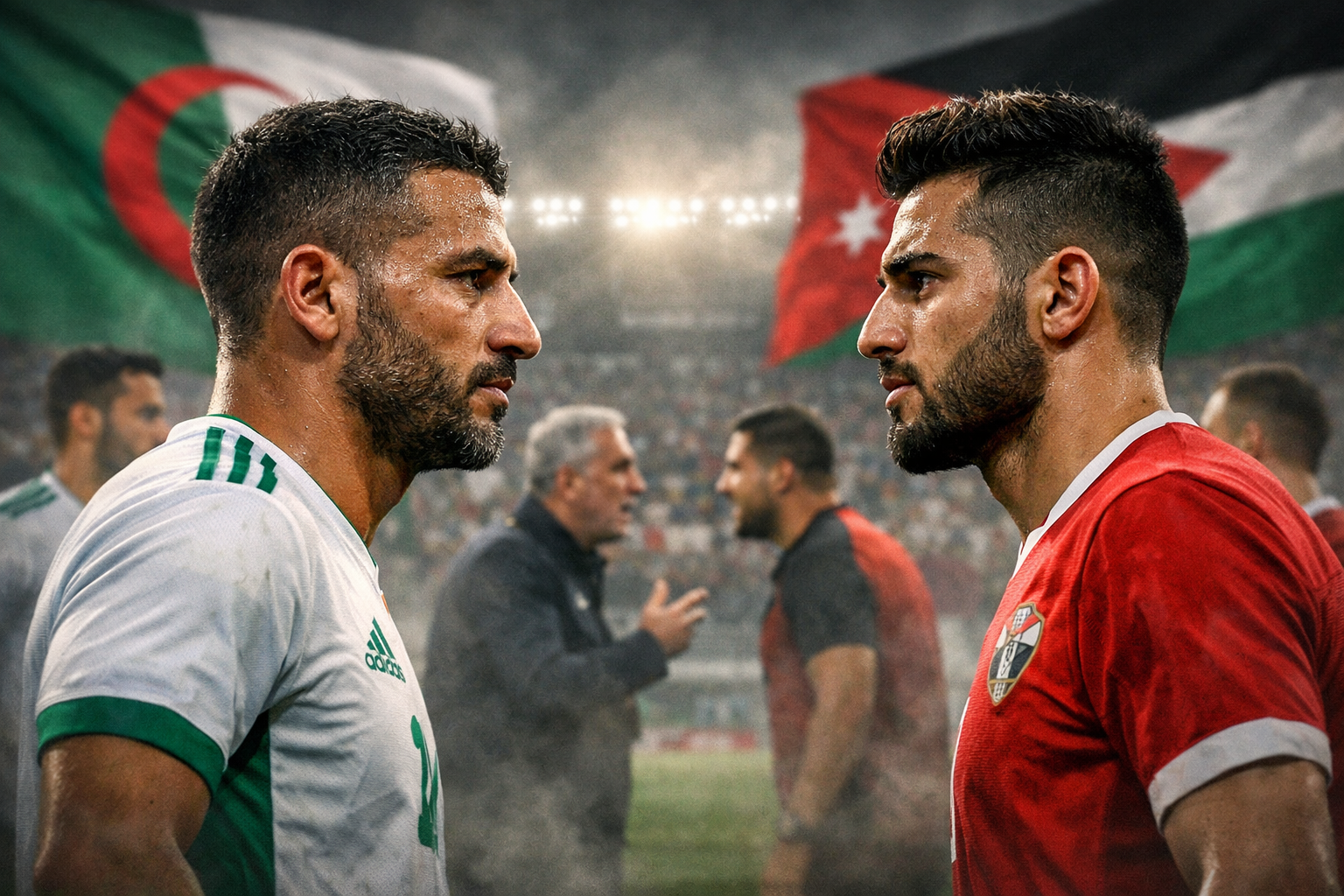
The calendar says Algeria and Jordan will not meet until June 23, 2026, but the temperature around the fixture has already begun to rise.
With the World Cup group stage looming, Algeria’s second Group J game is shaping up as one of the pivotal matches in its tournament. Vladimir Petkovic’s side opens against world champions Argentina on June 17 in Kansas City, then faces Jordan in San Francisco before closing the group against Austria five days later back in Kansas City.
On paper, the structure of the group is easy enough to read. Argentina is the heavyweight. Austria looks like a dangerous and disciplined opponent. That leaves Algeria and Jordan fighting over a result that could decide whether either side reaches the knockout rounds.
And now, long before the teams walk out, there is already a subplot.
Why Algeria-Jordan could define Group J
For Algeria, this World Cup has the feel of a major test and a possible transition point at the same time.
There is the expected spotlight on Riyad Mahrez, who at 35 is approaching what could be the final major tournament of his international career. Around him, Algeria still has enough quality to believe it can make noise in the group: Houssem Aouar and Amine Gouiri are back in the frame after missing the last Africa Cup of Nations, while Ibrahim Maza and Mohamed Amoura bring attacking spark and unpredictability.
Further back, the team still leans on the experience and edge of Ramy Bensebaini and Aissa Mandi, and there is also intrigue around the goalkeeping situation, with Luca Zidane a possible option if fully fit and available.
That mix gives Algeria talent, experience and enough individual quality to believe the round of 16 is achievable. But the route is not forgiving.
Taking points from Argentina would be a major surprise, even for a team with Algeria’s pedigree. That means the Jordan fixture starts to look less like a regular group match and more like a pressure point. Win it, and Algeria stays on track. Fail to do so, and the final game against Austria could become a must-win scenario with almost no margin for error.
The Zekri comments that stirred the build-up
Much of the early noise around the match has come from comments made by Noureddine Zekri, the Algerian coach currently working at Al-Shabab, who sit 13th in the Saudi league.
Speaking live on social media, Zekri delivered a blunt assessment of the coming World Cup meeting.
“If Algeria doesn’t beat Jordan in the World Cup, we will all have to retire. Jordan does not have the level of Algeria, and in no case can we put the two teams on an equal footing.”
It was the kind of line that travels fast, especially in a region where both national teams are followed closely and where many Jordan internationals are familiar figures. Zekri has worked in the Middle East since 2013, and one of the players under his management at club level is Ali Azaizeh, a forward for Jordan.
So these were not comments from a detached observer. They landed with extra weight because of his proximity to the regional game.
The broader message was clear enough: in Zekri’s view, Algeria should be beating Jordan, full stop.
That may reflect the perception many supporters hold when comparing the two squads historically, but saying it so directly turned a normal piece of tournament forecasting into a talking point.
Mousa Al-Tamari answers back
Jordan captain Mousa Al-Tamari did not let the remarks slide.
After his side’s 4-2 defeat to Lyon on Sunday, a game in which he still caught attention with an excellent volleyed goal, Al-Tamari was asked about Zekri’s statement. His response was sharp, even if he eventually struck a more diplomatic tone.
“I don’t know him, this is the first time I’ve heard of him. His statement is disrespectful, but we are respectful people, and I promise him that he will see something good in our match against Algeria.”
That quote alone adds bite to a fixture that already mattered. It also fits Al-Tamari’s role within this Jordan side. He is its leader, its star name, and often its attacking reference point.
At 28 years old, the winger has built a significant international record, reaching 90 caps and scoring 24 goals for the national team. He was central to Jordan’s run to the 2023 Asian Cup final, a tournament that helped shift outside perceptions of the team. Jordan no longer arrives as a side happy just to be present. It arrives with proof that it can compete deep into major events.
Al-Tamari eventually lowered the temperature, stressing that Algerians and Jordanians are “all Arabs and brothers.” Even so, the point had been made: Jordan has heard the noise, and it does not intend to accept a supporting role in this group.
Jordan’s rise makes this more than a routine game
If Algeria enters the matchup with greater history and more globally familiar names, Jordan comes in with momentum of its own.
Qualification for the 2026 World Cup without needing an Asian playoff was a significant step, and the team’s climb to 63rd in the FIFA rankings reflects steady progress rather than a one-off run. Jordan may not have Algeria’s depth of profile, but it has enough organization and belief to make life difficult in tournament football.
That matters because World Cup group games are rarely settled by reputation alone. They are often shaped by tension, game state, and who handles the moment better.
Jordan’s recent development suggests it will not approach the Algeria match as underdogs simply hoping to keep things respectable. With Al-Tamari leading the line emotionally and technically, this is a team that will believe it can make the game uncomfortable and potentially decisive.
Algeria’s pressure is different
The pressure on Algeria is not only about quality. It is also about expectation.
This is a national side that still carries the weight of past highs and near misses, and every major tournament tends to be judged against the idea of what Algeria should be. With Mahrez still around, experienced defenders in place, and several attack-minded players capable of producing moments, there will be an assumption from many supporters that the team should get out of this group.
But that expectation cuts both ways. If Algeria loses to Argentina in the opener, the Jordan match could become emotionally loaded before it even starts. Instead of being a chance to settle into the tournament, it would become a test of control, composure and efficiency.
That is why Zekri’s comments have resonated. They speak to a wider sentiment around the fixture: for many Algerian observers, beating Jordan is not being framed as an ambition, but as an obligation.
World Cups, of course, are rarely that simple.
A fixture with real stakes, long before kick-off
The most interesting part of this story is not the controversy itself. It is what the controversy reveals.
Algeria vs Jordan is already being treated like a hinge match in Group J. Algeria sees it as a game it must win if it wants to stay on course for the knockouts. Jordan sees it as a chance to prove that the gap in reputation does not decide the outcome. And with Austria still waiting in the final round of fixtures, the result could reshape the group table in a hurry.
For Algeria, the equation is fairly clear: survive the Argentina opener with belief intact, then handle business against Jordan before the probable showdown with Austria.
For Jordan, the opportunity is just as obvious: frustrate one of the group’s more established sides, lean on Al-Tamari’s quality, and turn the entire section into a far messier race than many predicted.
That is why this game is already alive in the conversation.
It is not just another group-stage date on the schedule. It is a clash wrapped in expectation, pride and tournament arithmetic. And after the first exchange of words, it now has the edge to match the stakes.
By the time Algeria and Jordan meet in San Francisco, the table may sharpen the pressure even further. But one thing is already certain: this one will not arrive quietly.