
Luis Enrique hails PSG’s latest final as reward for supporters after Bayern test
Paris Saint-Germain survived a ferocious semi-final against Bayern Munich to reach another Champions League final, with Luis Enrique praising his side’s character and defensive discipline after a 6-5 aggregate win.
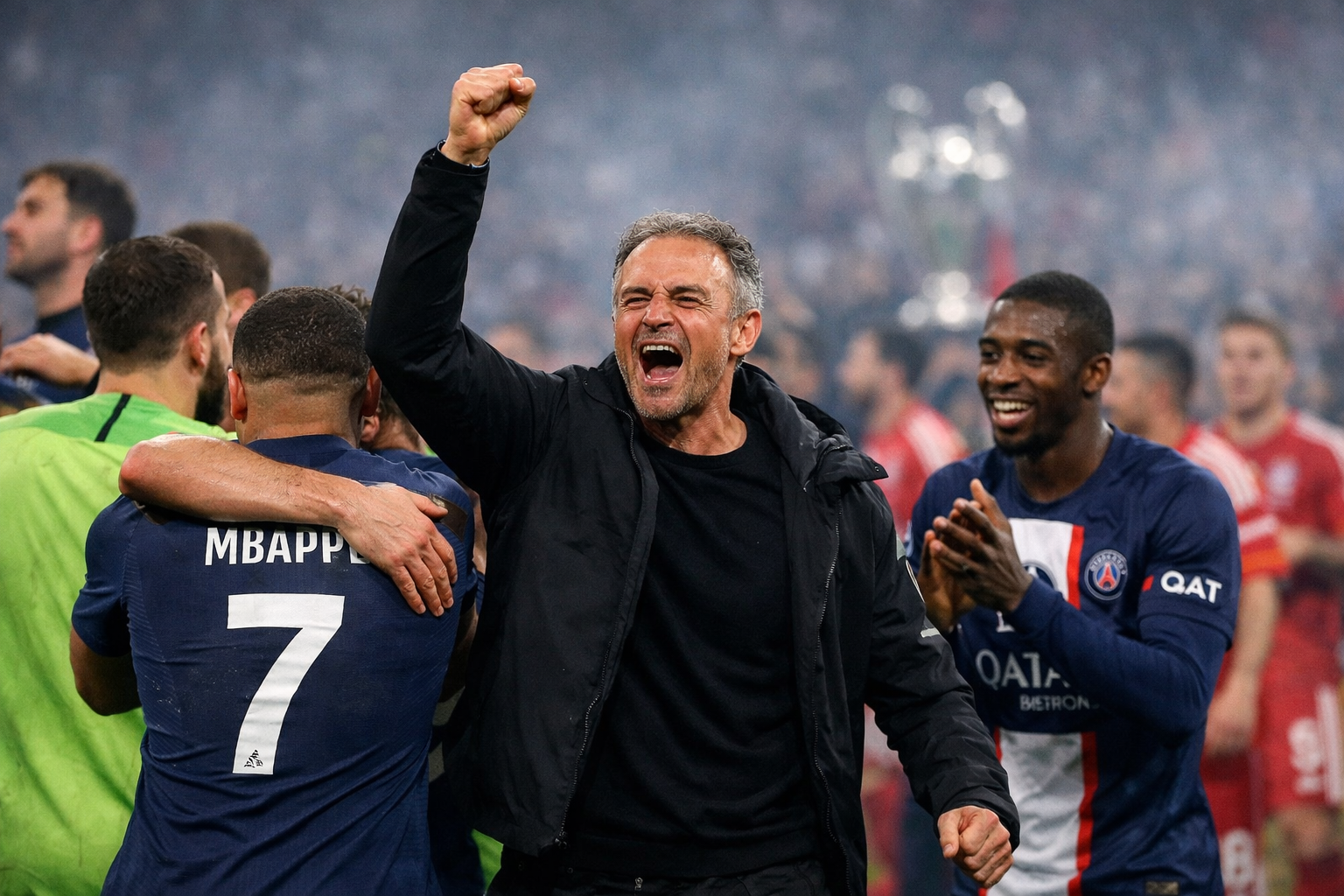
Paris Saint-Germain are one win away from another European crown after squeezing past Bayern Munich in a breathless Champions League semi-final, and Luis Enrique made it clear where he believes the moment belongs.
For the PSG manager, this was not just another milestone on an elite coaching CV. It was, in his words, a gift for the supporters.
After a 5-4 first-leg victory in Paris gave the French champions a slim edge, PSG travelled to Munich knowing the tie remained dangerously alive. They then struck almost immediately through Ousmane Dembele, whose third-minute finish altered the rhythm of the night and forced Bayern to chase. Harry Kane’s late equaliser in the second leg ensured a nervy ending at the Allianz Arena, but the 1-1 draw was enough. PSG advanced 6-5 on aggregate and booked a final against Arsenal.
The result sends them into back-to-back Champions League finals, a marker of consistency at the top end of Europe that very few clubs manage. It also underlined something slightly different about this PSG side: for all their attacking talent and gaudy scoring numbers, they were willing to suffer without the ball when the moment demanded it.
Luis Enrique’s message after another step forward
Speaking after the final whistle, Luis Enrique focused less on spectacle and more on the resilience his team showed over two high-level matches against one of Europe’s most demanding opponents.
He described the tie as intensely difficult and praised the character PSG displayed under pressure, especially against a Bayern side that kept forcing the pace. His broader point was simple: getting through a semi-final like this requires more than talent. It requires emotional control, defensive concentration and the willingness to adapt.
That adaptability was on show throughout the second leg. PSG, usually among the most proactive possession teams left in the competition, spent long spells without the ball. Bayern controlled more than 65 percent of possession, but PSG accepted that trade-off in exchange for compactness and transition opportunities.
For a side that has often been judged exclusively through its attacking stars, this was an important shift in image as well as tactic. PSG did not need to dominate every phase to survive. They needed to manage the game, absorb pressure and strike at the right moments.
Luis Enrique framed the qualification in emotional terms too, saying he wanted to give supporters a moment like this. It was a line that landed because PSG’s recent European story has been built on near-misses, scrutiny and the burden of expectation. Reaching another final does not erase that history, but it does show this team has developed a harder edge.
Dembele strikes early and changes the semi-final
The defining moment of the second leg arrived almost before Bayern had settled.
Dembele’s early goal gave PSG immediate breathing space and shifted the aggregate pressure sharply onto the hosts. It was the kind of away goal that changes everything psychologically, forcing the home side to open up and recalculate the risks they are willing to take.
The move itself owed plenty to Khvicha Kvaratskhelia, whose work in the build-up again highlighted just how central he has become to PSG’s attack. After creating the opening for Dembele, he continued to look like PSG’s most dangerous outlet, especially whenever space appeared in transition.
That contribution added another layer to an already exceptional European run. Kvaratskhelia became the first player to score or assist in seven knockout-stage matches in the same Champions League campaign, a remarkable measure of sustained impact in the competition’s highest-pressure rounds.
His production since arriving in Paris has been elite. Since his PSG debut in February last year, only Kane has registered more direct goal involvements in the Champions League. Kvaratskhelia’s combination of goals and assists has turned him into one of the defining players of this European season.
And if there was any doubt about his mentality after the match, he answered it directly. He called Bayern the toughest opponent PSG have faced this season, acknowledged the challenge Arsenal will present in the final, and said he would give everything for the badge.
That last line matters. PSG have often had world-class talent; what they have not always projected is collective conviction. In this tie, they looked more like a team than a collection of stars.
A different kind of PSG performance
There is a useful tension in PSG’s run to the final.
On one hand, this has been one of the most explosive attacking campaigns in Champions League history. Their tally of 44 goals in the 2025-26 edition is the second-highest ever recorded by a team in a single tournament, behind only Barcelona’s 45 in 1999-00. That number alone suggests chaos, control and relentless firepower.
On the other hand, the second leg against Bayern was shaped by restraint.
PSG did not play the game many expected. Instead of trading punches all night, they protected their lead in phases, defended deeper than usual and tried to punish Bayern on the break. Desire Doue and Kvaratskhelia both had chances to stretch the lead further in the second half, and had one of those gone in, the closing stages may have felt more comfortable.
Instead, Kane’s stoppage-time goal ensured there would be one final wave of tension. Bayern threw everything forward. PSG had to hold their nerve. They did.
That ability to win in multiple ways is often what separates finalists from champions. Attacking quality gets you noticed, but game-state management gets you through semi-finals. Luis Enrique will take encouragement from the fact his team showed both.
What the Arsenal final now represents
Now comes Arsenal, and with that, a final loaded with narrative.
PSG will enter the showpiece knowing they are no longer just the glamorous project trying to prove it belongs at Europe’s top table. They are defending champions with a chance to retain the trophy and place themselves in rare company. Reaching consecutive finals already sets them apart. Winning back-to-back titles would move this era of the club into a different bracket entirely.
For Luis Enrique, it is also the chance to complete another tactical chapter. His team have spent this run blending old PSG strengths with newer ones: pressing high when possible, countering quickly when needed, and showing greater patience without the ball. Arsenal will test all of that.
The Premier League side have navigated their own difficult path to the final and are unlikely to offer PSG many comfortable phases. That should make for a fascinating contrast: Arsenal’s structure and control against a Paris side capable of flipping matches in a matter of seconds.
But before the tactical board fills up with final-week detail, PSG can pause for one simple truth. They came through one of the hardest assignments in European football.
Bayern pushed them deep, forced them to defend, and threatened to drag the tie into chaos. PSG responded with an early statement, enough discipline to protect their aggregate edge, and enough quality in decisive moments to survive.
Luis Enrique called it a gift for the supporters. After a semi-final this intense, they have certainly earned the right to enjoy it.
And if PSG go on to finish the job against Arsenal, this semi-final may be remembered as the night they showed they can do more than dazzle. It may be remembered as the night they proved they can endure.