
How Brøndby’s Turbulent Years Helped Shape Thomas Frank
Before earning praise at Brentford, Thomas Frank endured a bruising spell at Brøndby marked by academy reform, rising expectations and boardroom chaos.
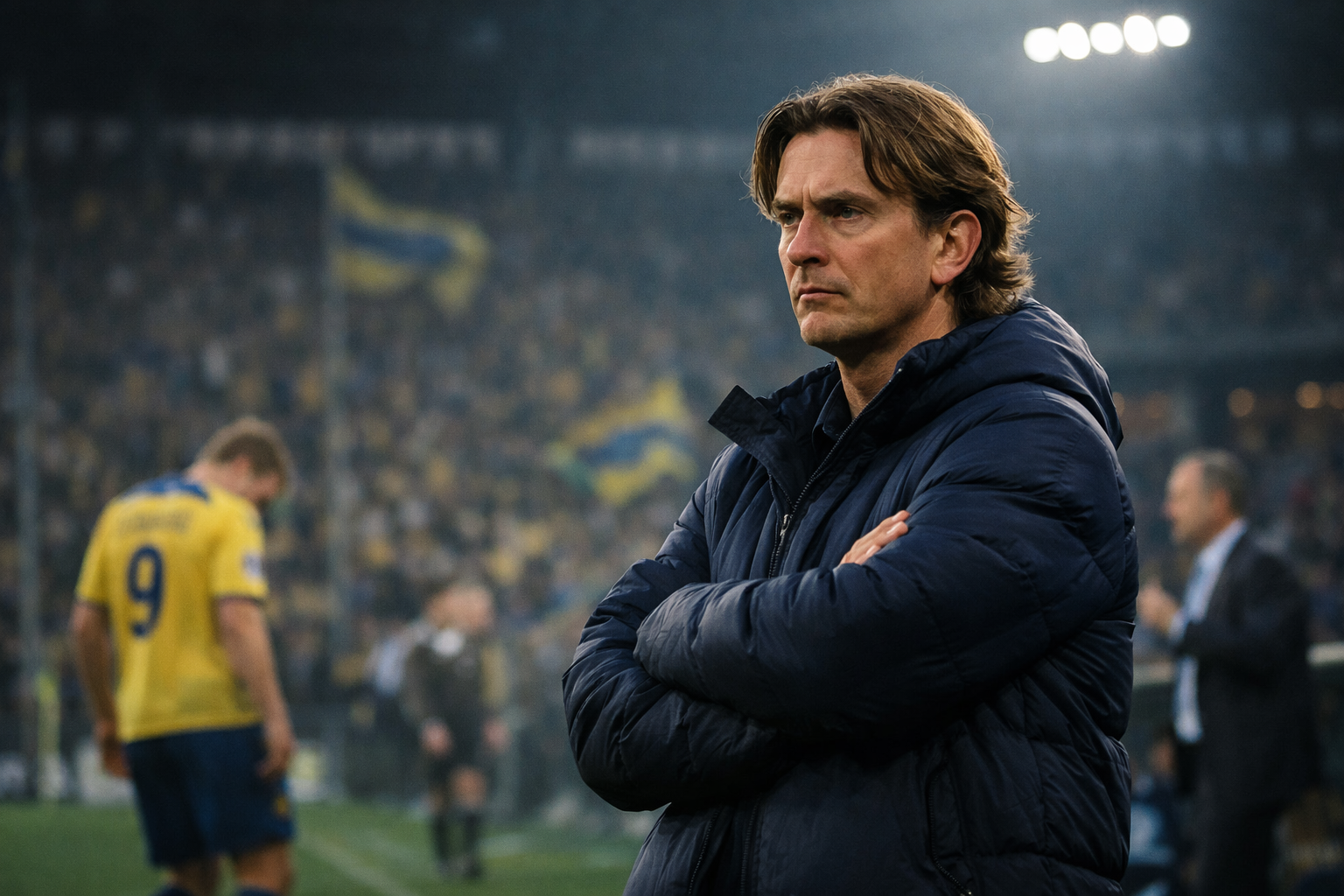
Thomas Frank is now widely regarded as one of the most impressive coaches in the game. At Brentford, he has built a reputation for sharp management, smart player development and a style of leadership that makes him one of the most respected figures in the Premier League.
But the version of Frank that English fans know was not formed in comfort. Long before his success in west London, he went through a harsh education at Brøndby, where ambition, instability and public pressure collided. That period did not deliver the trophies many had hoped for, yet it proved crucial in shaping the coach he would later become.
A first senior job in the middle of a rebuild
When Brøndby appointed Frank in the summer of 2013, the club was in no position to think only about titles. One of Denmark’s biggest names had just survived a relegation fight and had also come dangerously close to financial collapse. New ownership had stepped in, but the situation remained fragile.
Frank arrived with a strong reputation in youth football rather than senior management. He had worked successfully with Denmark’s age-group national sides and was highly regarded for his ability to teach, communicate and improve young players. For a club needing to rebuild carefully, that profile made sense.
Brøndby’s plan was clear enough on paper. The club could not outspend FC København, so it needed to lean heavily on player development. Too many prospects had already slipped away before making a full first-team impact. Talents such as Andreas Christensen, Pierre-Emile Højbjerg, Patrick Olsen, Nicolai Boilesen, Markus Bay and Jannik Vestergaard had all moved abroad early.
The idea was to stop that pattern. Brøndby wanted its best young players to progress into the senior side, strengthen the team and eventually generate major transfer income.
Frank looked like the right coach for that strategy. He knew how to work with younger footballers, and he already had relationships with some of the players expected to form the club’s next core.
The Masterclass vision
Brøndby did not only talk about development. During Frank’s first season, the club launched a more ambitious academy structure under the Brøndby Masterclass banner. It was a serious investment, both financially and ideologically.
The most eye-catching move was the arrival of Albert Capellas, who had previously worked at Barcelona’s famed La Masia setup. His appointment as assistant coach underlined what Brøndby wanted to become: a club built on modern coaching, technical education and long-term thinking.
At first, there was patience from the top. The board publicly emphasized process over panic. After years of expensive mistakes and frequent changes, the message was that Frank would be given time. The club insisted it would judge progress, not just short-term turbulence.
That backing was important because the early results were rough. Brøndby went seven league matches without a win at the start of the campaign and also suffered an embarrassing cup exit against part-time opposition. The rebuild was not moving smoothly.
Still, the season gradually settled. Reinforcements arrived, including experienced names like Thomas Kahlenberg and Khalid Boulahrouz. Their presence added authority to a group that also contained promising but still-maturing players such as Riza Durmisi, Christian Nørgaard and Kenneth Zohore.
By the end of the season, Brøndby had climbed to fourth place and qualified for Europe. Given where the club had started, it was a respectable step forward.
A change in ownership, and a change in tone
That progress came just as the environment around Frank began to shift.
During the season, investor Jan Bech Andersen acquired a controlling stake and became the central figure at the club. With him came a more aggressive tone. The language of rebuilding and patience started to give way to talk of titles, expectations and closing the gap to Copenhagen.
That change mattered. Frank had been hired for a long-term project, but the target around him was suddenly moving.
His second season brought even more pressure because Brøndby were approaching the club’s 50th anniversary, and optimism grew quickly. Young players had another year of experience, and the board spent heavily.
Daniel Agger returned from Liverpool in a headline-grabbing homecoming. Johan Elmander also arrived, adding another familiar and celebrated name. Publicly, the objective was a top-three finish. Inside the club, the ambition was clearly larger than that.
On paper, the squad looked stronger. On the pitch, the picture was much less convincing.
Possession without punch
Brøndby’s football under Frank aimed for control. His preferred 4-2-3-1 was built around possession, structure and patient progression. The problem was that control did not consistently produce danger.
The team often struggled to create chances, even against lesser opponents. When goals came, they frequently felt disconnected from the collective plan, relying more on individual quality than on a fully functioning attacking structure.
There were flashes. A home win over FC København provided a reminder of what the side might become. But those moments were too often followed by flat performances and dropped points. One of the clearest examples came against newly promoted Hobro, a club with far fewer resources and expectations. Brøndby faced them three times and failed to win any of those games.
In Europe, the limits of the project were exposed as well. Club Brugge comfortably knocked Brøndby out of Europa League qualifying with a 5-0 aggregate victory.
As the results wobbled, supporters began to question whether Frank’s calm, modern and relatively soft-edged approach was enough for a club of Brøndby’s size. He remained a likable figure, but warmth alone does not survive forever at a demanding institution.
The Hoffenheim humiliation and a crack in authority
One episode from the following winter said a great deal about how fragile Frank’s authority had become.
Brøndby were hammered 7-0 in a friendly by Hoffenheim. The scoreline was bad enough, but the fallout was worse. Reports later emerged that Frank had sought Daniel Agger’s view on how to respond and whether the squad should be punished.
Agger, a strong personality and an old-school dressing-room figure, reportedly pushed for a harder reaction. He believed the team should be called back in during their days off and made to face the consequences physically and mentally.
Frank eventually acted, but the broader damage was already there. If a coach is seen as uncertain in moments like that, senior players notice. Years later, Agger spoke openly about liking Frank as a person while being less convinced by him as a coach in that period. He described a lack of hierarchy and discipline compared to the type of environment he valued.
That criticism was revealing. Frank’s methods were not simply under external pressure from fans and media; they were also being tested inside the dressing room.
Results that never matched the investment
Brøndby did finish third that season, which formally met the club’s published target. Yet the numbers behind it were unconvincing. They ended 16 points behind champions Midtjylland and scored only 43 goals in 33 league matches.
The following campaign brought more setbacks. PAOK thrashed Brøndby 6-1 in Europa League qualifying, another painful reminder that the team was not progressing as hoped. Domestically, the side drifted into the lower half of the table and entered the winter break in fifth place, far from any genuine title race.
By that stage, support for Frank had eroded badly. Brøndby had invested significant money in the squad, but expensive players were not thriving. The attack remained blunt. The style looked rigid. Questions grew louder from supporters, pundits and influential voices around the club.
Then the story took an extraordinary turn.
The forum scandal that ended it
During that bleak winter, a user named “Oscar” appeared on the Brøndby fan forum Sydsiden Online and began posting fierce criticism of Frank and sporting director Per Rud. The comments accused the pair of poor recruitment, tactical stubbornness and weak leadership. They also suggested change was imminent.
In March, it emerged that “Oscar” was not an ordinary supporter at all. The man behind the account was chairman Jan Bech Andersen.
That revelation effectively made Frank’s position impossible. Public criticism from fans is one thing; anonymous attacks from the chairman on a supporters’ forum are something else entirely. Soon after the story broke, Frank resigned following a defeat to SønderjyskE.
Andersen also stepped down as chairman in the aftermath, though he later returned.
For Frank, it was the end of a bruising first experience as a senior head coach.
Why Brøndby still mattered
Frank did not walk straight into another major job. He spent months out of work before joining Brentford as an assistant in late 2016. From there, the next chapter slowly began.
Yet it is hard to understand his later success without looking closely at Brøndby. That spell exposed him to nearly every challenge a coach can face early in his career: rebuilding a fallen club, handling inflated expectations, managing big personalities, surviving tactical criticism and working amid boardroom instability.
It also appears to have changed him. Observers in Denmark noted that he became tougher over time. The idealism remained, but there was more realism too. He learned that a coach cannot always rely on one model regardless of context. He learned that authority must be visible, not assumed. And he learned how quickly a club can become unmanageable when the message from above shifts.
At Brentford, Frank has often looked like a coach with both warmth and steel. He still values relationships, communication and development, but there is also more edge, more flexibility and more clarity in how he leads.
Brøndby was not the triumph he wanted, and for a long time it looked like the failure that might define him. Instead, it became the difficult apprenticeship that helped prepare him for everything that followed.
In football, success is often built on the lessons taken from the wrong turns. For Thomas Frank, many of those lessons were learned the hard way in yellow and blue.