
When Bayern Munich Looked Mortal: Revisiting the Chaos of 1991/92
Before serial titles became routine, Bayern Munich endured a season that cracked the aura of inevitability. The 1991/92 campaign remains the club’s modern low point.
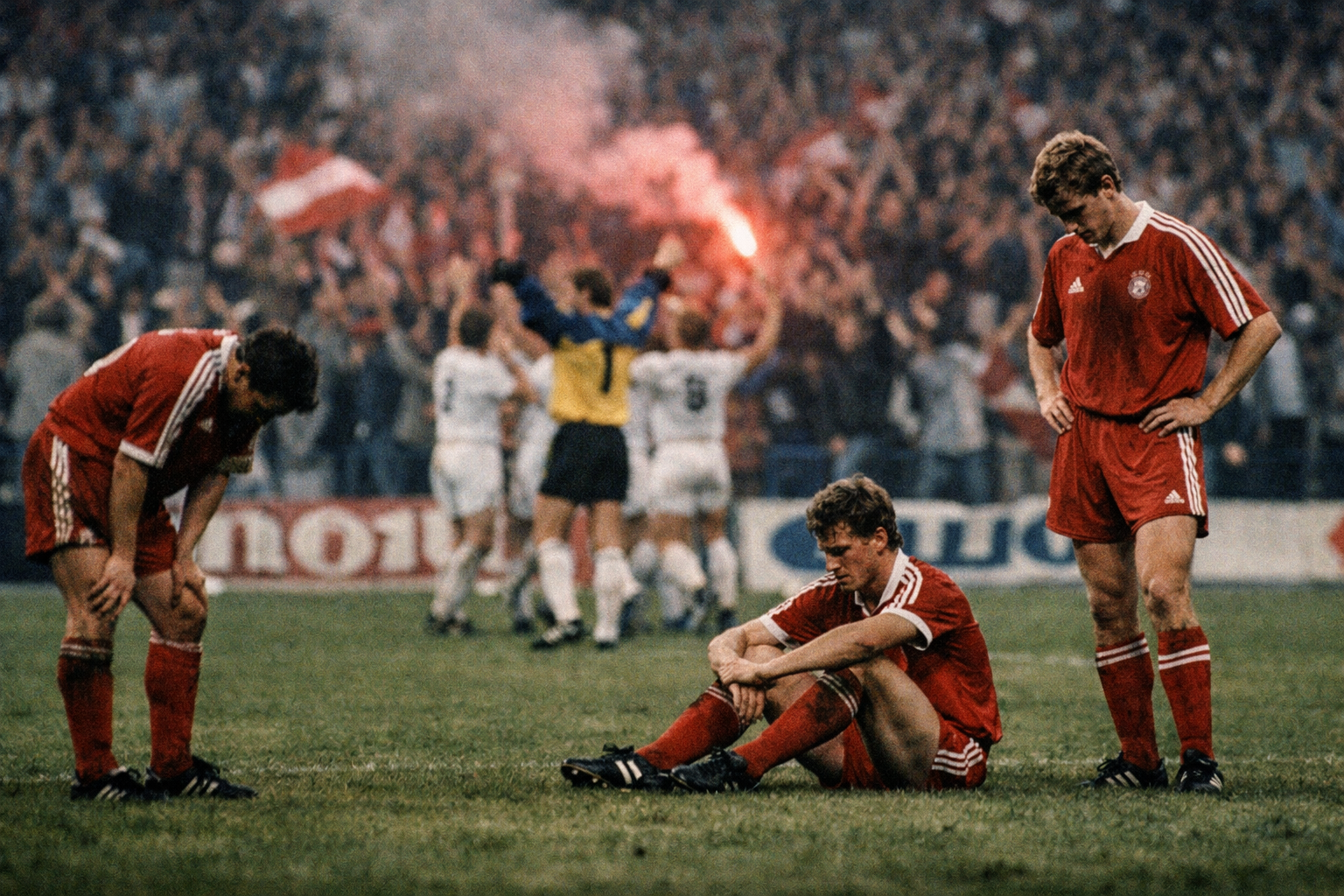
Bayern Munich are supposed to be the constant.
In German football, they are the reference point: the club of European Cups, domestic titles and generation after generation of elite talent. When Bayern wobble, the scale is usually relative. A disappointing season in Munich often still ends with silverware, a title race, or at minimum a place near the top.
That is what makes 1991/92 such a fascinating outlier.
For one season, Bayern looked ordinary. Not dramatically, existentially broken in the way some giant clubs have been at different points in history, but undeniably vulnerable, confused and strangely beatable. By the standards of a club built on dominance, it was a collapse. By the end of the campaign, Bayern had finished 10th in the Bundesliga, posted a negative goal difference and churned through three different managers. Cup exits piled up, reputations took damage and the aura vanished.
It remains the closest thing modern Bayern have had to a lost year.
The warning signs were easy to miss
The slump did not arrive out of nowhere, but it certainly did not feel inevitable.
Under Jupp Heynckes, Bayern had been strong at the turn of the decade. They won the Bundesliga in 1988/89 and 1989/90, and in Europe they were still a serious force. The 1990/91 season ended without a title, but Bayern still finished second and came within touching distance of the European Cup final.
That near-miss still stings in hindsight. Red Star Belgrade beat Bayern 2-1 in Munich in the first leg of the semi-final, leaving the Germans with a brutal task away from home. Bayern nearly pulled it off, leading 2-1 on the night and pushing the tie toward extra time, only for Klaus Augenthaler’s late own goal to send Red Star through. It was devastating, but not yet a sign that the floor was about to give way.
If anything, Bayern looked like a team trying to reload rather than rebuild.
Stefan Effenberg had arrived, along with Brian Laudrup and Christian Ziege, and the squad still contained enough quality to expect a title challenge. Effenberg, never one to hide, announced himself with typical edge, saying he joined Bayern because other clubs were “too stupid” to win the Bundesliga. It was vintage Effenberg: confident, provocative, combustible.
But the confidence of that era soon curdled into something else.
A poor start became a pattern
Bayern opened the 1991/92 Bundesliga season with a draw at Werder Bremen and then lost at home to promoted Hansa Rostock. A late winner against Fortuna Düsseldorf settled some nerves, but only briefly. Early-season inconsistency can be absorbed by top teams; Bayern, though, were not just searching for rhythm. They were already showing signs of fragility.
Then came the first real shock.
The Homburg humiliation
In the DFB-Pokal, Bayern hosted FC Homburg, a second-tier side from the Saarland. On paper, it should have been procedural. In practice, it became the kind of result that hangs around a club for decades.
Only around 9,000 turned up at the Olympiastadion, and the atmosphere never felt right. Bayern took the lead through Mazinho and seemed to be moving along without much fuss. But Homburg equalised through Rodolfo Cardoso, then struck again when Matthias Baranowski punished a defensive lapse.
Mazinho rescued Bayern again to force extra time, and that should have been the moment the heavyweight finally asserted itself.
Instead, Homburg kept swinging.
Michael Kimmel made it 3-2 in extra time. Bernd Gries added another. Bayern were 4-2 down at home to second-division opposition, and this time there was no late rescue. The final whistle landed as a genuine embarrassment: Bayern out of the cup at the first hurdle, beaten in Munich by a side few expected to trouble them.
For a club that built its identity on authority, it was an early public crack.
Cork City and the sense that something was off
Sometimes a cup upset is just that, a bad night filed away as an anomaly. Bayern did not get that luxury.
Their league form continued to drift, and by the time they entered the UEFA Cup they were sat in seventh place. The first-round draw, against Cork City, looked kind. Bayern were full-time professionals with international pedigree. Cork, by comparison, were part-timers from a club formed only a few years earlier.
Yet the first leg in Ireland became another uncomfortable chapter.
Dave Barry, a local sportsman with a background in Gaelic football as well as association football, put Cork ahead after Bayern were caught high up the pitch. Effenberg equalised before half-time, but the expected Bayern surge never really came. The match finished 1-1, a result celebrated in Cork and viewed with unease in Bavaria.
The return leg did not settle things much either. Cork held out until the 71st minute before Bruno Labbadia finally broke through, and Bayern only added a late penalty to make the scoreline look more convincing than the performance.
They advanced, but not like Bayern. That distinction mattered.
The end of Heynckes’ first spell
The pressure kept building.
Just days after scraping past Cork, Bayern were thrashed 4-1 away by Stuttgarter Kickers. That result proved terminal for Heynckes, who was dismissed in October.
History has added a heavy layer of irony to that decision. Heynckes would go on to become one of the defining managers of Bayern’s modern era, returning later to win the Champions League and complete the 2013 treble. Uli Hoeness would eventually describe sacking him in 1991 as the biggest mistake of his business life.
At the time, though, Bayern felt they had to act.
Their next move only deepened the disorder.
Soren Lerby and the spiral
Franz Beckenbauer was approached and declined. Bayern then turned to Soren Lerby, a former player with immense standing at the club but almost no managerial track record. In fact, he had only recently retired and did not even hold the required coaching licence.
It was a gamble dressed up as a solution.
Lerby’s start was rough. Defeats to Borussia Dortmund and VfB Stuttgart dragged Bayern down to 14th in the table, alarmingly close to the relegation places in a 20-team league. Then Europe delivered the season’s most surreal scoreline.
The night in Denmark that defined the collapse
In the second round of the UEFA Cup, Bayern met Boldklubben 1903 of Denmark, a modest club soon to become part of the merger that formed FC Copenhagen. Bayern were expected to get through. Instead, they suffered one of the heaviest and strangest defeats in their European history.
Mazinho gave Bayern the lead in the first leg, but that only prefaced the chaos. Boldklubben equalised, then exploded after the break. A penalty from Ivan Nielsen made it 2-1. Kenneth Wegner added a third. Michael Manniche struck again. Bayern had conceded three times in seven second-half minutes and were falling apart in full view.
It got worse.
Brian Klaus scored. Peter Uldbjerg scored. By the end, the scoreboard read Boldklubben 1903 6-2 Bayern Munich.
For any club, that would be a headline result. For Bayern, it felt almost unreal.
The second leg brought little redemption. Bayern won only 1-0 and exited the competition meekly. By then, the season had acquired its own destructive momentum: cup embarrassment at home, European humiliation abroad, league form collapsing in between.
No reset, no rescue
Lerby lasted until March, when a 4-0 defeat at Kaiserslautern finally ended his brief and bruising time in charge. Bayern then turned to Erich Ribbeck, an experienced Bundesliga coach tasked with bringing a little order to a campaign already well beyond repair.
Ribbeck did at least stop the season from becoming even darker, but he could not restore meaning to it. In his 11 league matches, Bayern won five and lost five. They remained what they had become all year: unstable, streaky and far removed from title level.
When the Bundesliga season ended, Bayern sat 10th.
Mid-table. Negative goal difference. More defeats than victories. Seven home losses.
For most clubs, that would be forgettable. For Bayern, it was almost unthinkable.
While the title race produced final-day drama elsewhere, with Stuttgart edging out Dortmund and Frankfurt in one of the Bundesliga’s great finishes, Bayern were reduced to spectators. They were no longer shaping the season. They were watching it happen without them.
Why it still matters
The aftermath is part of why 1991/92 now feels so significant.
Bayern responded the way powerful clubs usually do: quickly and expensively. Thomas Helmer arrived. So did Jorginho and Mehmet Scholl. Most notably, Lothar Matthäus returned. Effenberg and Laudrup moved on, and the squad was reset.
The bounce was immediate. Bayern finished second the following season, just one point behind Werder Bremen, and the broader arc of the club bent back toward what we now recognise as normality. The 1990s would still bring volatility, celebrity, internal drama and the “FC Hollywood” label, but never again would Bayern sink quite this low in the modern era.
That is why 1991/92 remains such a useful reminder.
It shows that even institutions built to win can drift when recruitment misfires, coaching decisions become reactive and confidence evaporates. Bayern were not short of famous names or resources. What they lacked was clarity, balance and stability. Once those disappeared, the shirt alone could not carry them.
There is also something healthy, from a historical point of view, in remembering that Bayern were not always the untouchable machine many now assume them to be. Dominance can create the illusion of permanence. Seasons like 1991/92 break that illusion.
For one year, Bayern looked human.
And because they have spent so much of the time since looking invincible, that human season still stands out more than three decades later.